
Journal
Why we are switching to capacitive probes before continuing the project
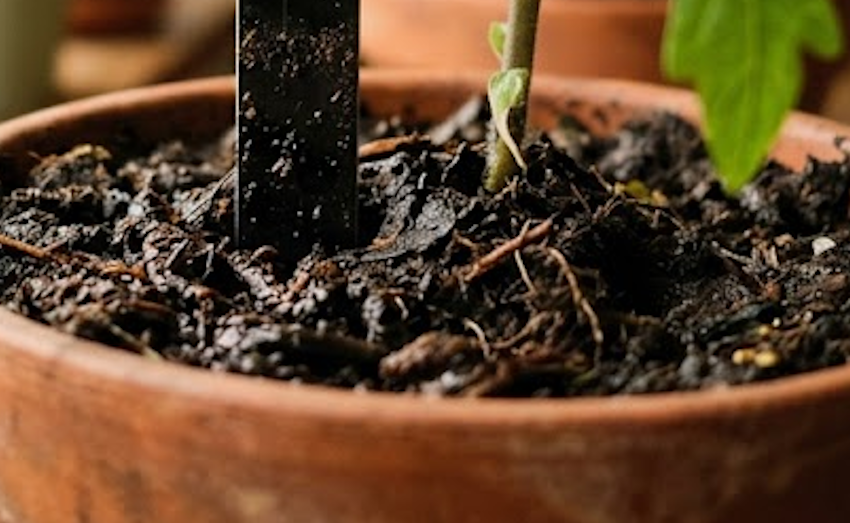
Building something properly sometimes means stopping to fix the foundations, and that is exactly what we are doing. Before we carry on adding features to PlantSense, we are changing the soil probe at the heart of every monitor from a resistive type to a capacitive one. Here is what we found, why it matters, and what it means for you.
What we noticed
During testing, a couple of monitors did something that should be impossible. Sitting indoors overnight, with no watering, their readings climbed steadily from the seventies all the way up to a pinned 100 per cent by morning. Soil left alone indoors can only dry out, so a rising reading is a sure sign the number was not tracking the soil at all.
Why it happened
The early monitors use a resistive probe. It measures moisture by passing a small electrical current between two metal prongs, and wetter soil carries that current more easily. It works, but it has a well known weakness. When a voltage sits across those prongs all the time, the metal slowly polarises and begins to corrode, a process called electrolysis. As that happens, the probe reads as though the soil is getting wetter and wetter, even when it is not. The drift is gradual, it builds through the night, and it eventually pins the reading at the top of the scale.
The important part is that nothing was broken in the app or in the maths. The monitor was reporting exactly what its sensor told it. The sensor itself had drifted. You can patch it by recalibrating, but because the cause is the probe being powered continuously, it simply drifts again a day or two later. Recalibration is a plaster, not a cure.
Why capacitive probes fix it
A capacitive probe measures moisture in a completely different way. Instead of passing current through the soil, it senses the change in an electrical field around a sealed, coated surface. No current flows between bare metal and the soil, so there is nothing to electrolyse and nothing to corrode. That brings three real advantages:
- No drift from electrolysis. The reading stays honest over days and weeks, not hours.
- They last. With no corroding prongs, a capacitive probe holds up far longer in damp soil.
- They hold their calibration. Set it once and it stays put, so a dry morning reads as dry.
Capacitive probes are not perfect, as they drift a little with temperature, but that effect is small and far more manageable than the runaway drift of a continuously powered resistive probe.
Why we are switching now, before adding more
Everything we are building next, the apps, the watering reminders, the history and trends, all of it stands on one thing being true: the moisture reading has to be trustworthy. There is no sense polishing the roof while the foundation is moving. Switching the probe now means every feature we add from here sits on a reading you can rely on, rather than us bolting workarounds onto a sensor that was always going to fight us. Do it once, do it right, then carry on.
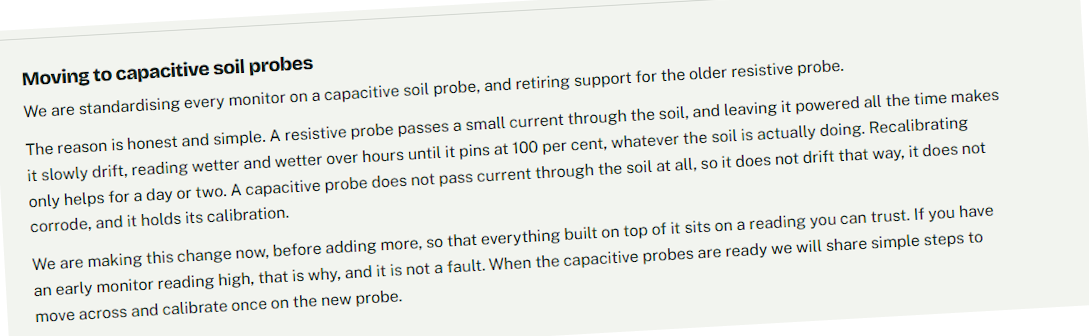
You may have noticed in our public Changelog our entry :-
What this means for you
If you have an early monitor with a resistive probe and it is reading high, or creeping upward on its own, this is the reason, and it is not a fault in your unit. Your monitor still works, and it still watches your soil on your own network. If you want a quick sanity check in the meantime, lift the probe into open air: a healthy sensor will jump to nearly dry, which shows it is reading, just drifting. When the capacitive probes are ready we will share simple steps to move across and recalibrate once on the new probe.
In the meantime, the plant database keeps growing, now well into the hundreds of plants across fruit, vegetables, herbs, houseplants and more, each with its own watering guide ready for the day your readings are rock solid.
Thank you for bearing with us while we get the important part right. It is the difference between a gadget and a tool you can trust.
Leave a comment